Foundational Setting: Glorantha
I published this video in September, 2025, and am finally putting it in blog form for those who prefer to read. Like Burger King, here at Setting First, we let you have it your way. Watch it or read it, as your preferences dictate:
Glorantha, the setting for Chaosium’s RuneQuest, is possibly the ultimate foundational tabletop RPG setting. “Foundational” is my term for a setting that has breadth and depth and provides endless possibilities, in a framework that makes it feel real. You just never run out of things to do with Glorantha.
This is a world that first came into the imagination of its creator, the legendary game designer Greg Stafford, in 1966. It’s been in continuous development since then. There’s a lot to it. Many areas are described in great detail, and there are also plenty of areas in Glorantha that haven’t been fully described in any publication. But regardless of where in Glorantha you situate your campaign or how you bend it to fit your needs, it’s all good.
I’m going to explain why I think Glorantha is a foundational setting, then tell you how to dip your feet into it and start exploring without getting overwhelmed.
A foundational setting offers five things: breadth, depth, consistency, support, and compatibility.
The Elements of a Foundational Setting
Breadth
Glorantha consists of two continents, each about twice the size of the European Union, and many smaller islands. It contains a broad range of cultures, ranging from the herd people of the Praxian wastelands, to the sophisticated urbanites of Lunar cities, to the hill people of Sartar, and the sailors of northern Pamaltela.
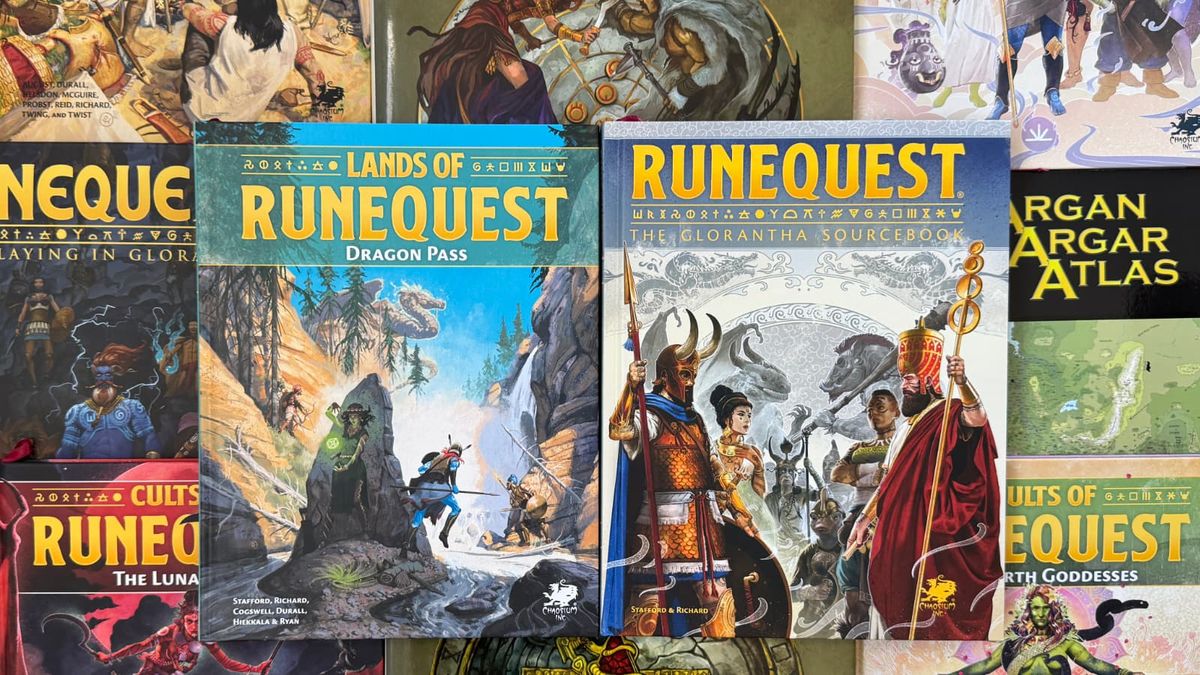
While more has been written about the center of Genertela, the northern continent, than the rest of the world, all of it has been mapped out in the Argan Argar Atlas, with cultures for every corner of the world defined in the massive Guide to Glorantha, giving GMs base ingredients they can build upon to create a wide variety of campaigns. As a GM, you can take a less-defined area like Pamaltela or somewhere else and make it your own, or run published adventures from the more well-defined areas.
Depth
Speaking of well-defined areas, many of the regions in and around Dragon Pass have been fleshed out in superb detail. That detail encompasses gods, cultural practices, politics, how trade functions, and much more. I ran two multi-year campaigns in Dragon Pass and Prax, and I could easily run a new campaign right now without redoing any of what I did before.
Consistency
Glorantha is a Bronze Age world, one where many types of magic permeate everything. The gods are very real — they’re not abstractions. Which god or gods a character worships has immediate, tangible bearing on their interactions with other characters. None of it feels bolted on. It’s consistent in that it feels organic and of a whole. Gods and magic feel more real than in any other game world I’ve encountered.
There are definitely oddities to this world — most notoriously, the ducks. They’re weird, no doubt. But Glorantha is a world that doesn’t attempt to explain everything in a logical way. This is how a magical world operates. As a result, it feels real in an odd but unforced way. The setting truly comes first in Glorantha.
Support
Glorantha benefits from decades’ worth of published material, and many of the setting books — including the Guide to Glorantha — are pure lore with no stats or other game-specific information. There’s a wealth of official RuneQuest material from Chaosium, and through their Jonstown Compendium program there’s also an enormous volume of very high-quality support material that continues to be produced by fans who know the world inside and out — some of them must-have resources for any serious student of Gloranthan lore.
There are also older Chaosium materials created for earlier editions of RuneQuest which can be converted for use with the current edition without much effort.
Compatibility
This is a personal matter, a matter of taste. As a GM, you really have to enjoy a world and want to keep exploring it if you’re going to be running it for lengthy campaigns over potentially years.
Even back in the early ‘80s when I first encountered RuneQuest, I was struck by how it offered a completely different kind of fantasy setting. It didn’t reduce the competing gods, cultures, and races to good and evil. Trolls, for example, were presented in all their complexity. In RuneQuest, they can be very dangerous foes, staunch allies, or a mix of the two. Depending on cult affiliations and personal motivations, a troll may support or oppose player characters — and they’re a playable race. Remember, this is from the early ‘80s.
In RuneQuest, Chaos is the enemy, but the Lunar Empire coexists with and sometimes leverages Chaos to defeat its foes. Yet those who fight against Chaos and the Lunars aren’t without fault either. There’s a multiplicity of relationships between groups, and your cultural and religious affiliation matters in very tangible ways. Gloranthan history is also full of examples of individuals who crossed those lines, defeated overwhelming foes, and created unique empires.
So what does this all mean for tabletop roleplaying? Glorantha is a rich, dynamic, amazingly detailed, and yet still very open world. For example, I’ve long wanted to run a campaign on the southern continent of Pamaltela. Much has been written about it, but there haven’t been many adventures set there, and I could open up an entire region and flesh it out myself.
How to Get Started
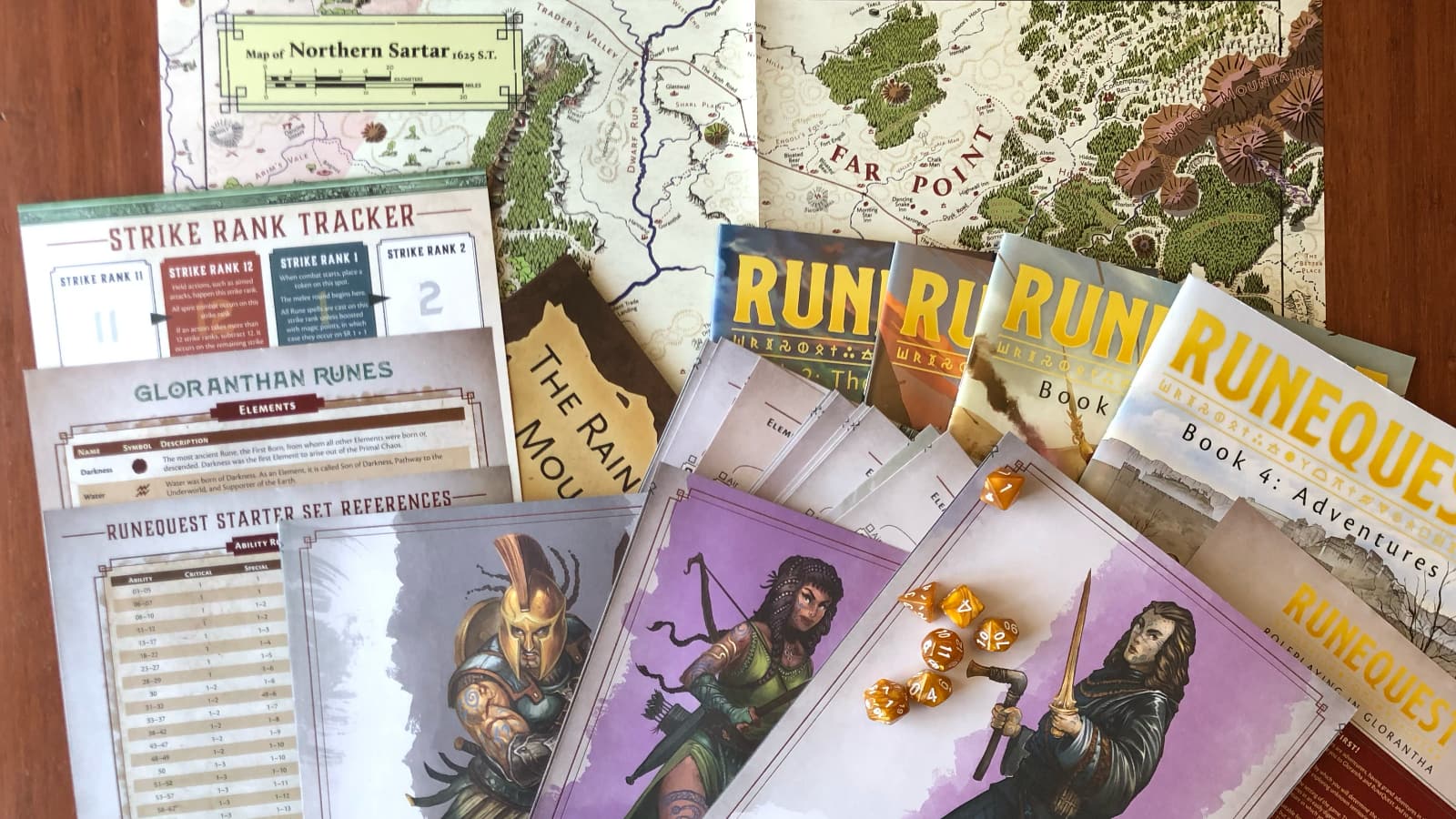
If you want to explore Glorantha and get to know it, there’s a free PDF quickstart for RuneQuest so you can understand whether you’re interested in the rules themselves. If you like that, get the starter box set — it’s fairly incredible for the price. You get the basics of the rules, a full solo adventure, just the right amount of information about the setting to get you going, four interlinked adventures for your players, several pre-generated characters, maps, dice, and an introduction to the broader world of Glorantha. I’ve been into tabletop roleplaying for a long time, and I’ve never seen a beginner box set that does a better job of introducing a complex world to GMs and providing a smooth on-ramp to that world.
If you use the box set and find yourself wanting to run a campaign, you’ll want the slipcase, which includes the core rulebook, the Glorantha Bestiary, and the GM Pack, which includes some adventures and a GM screen. This will give you enough to run a campaign centered in Dragon Pass. From there, you can add the Cults of RuneQuest books and the regional sourcebooks and adventures, not to mention whatever strikes your fancy from dozens of third-party supplements and adventures.
If you want to go beyond Dragon Pass and the nearby areas, the Guide to Glorantha gives you maps and all kinds of information you can build upon. This is a massive two-volume set that serves as the core setting canon used by Chaosium and third-party publishers.
If you’ve been looking for a fantasy setting that provides real verisimilitude, tons of inspiration for you as a GM, and a combination of well-developed regions and areas open for you to build out as you see fit, you really owe it to yourself to check out Glorantha.
Ω
Itching to talk about this or other Setting First topics? Head over to our small but mighty Discord!